Showing posts with label Scratchbuilt. Show all posts

Saturday, December 13, 2025

Thursday, October 3, 2024

Chain of Command: Jump Off Points for my US Boys

As I wanted some thematically appropriate Jump Off Points for my US Boys, I used some leftover miniatures from my AD- and Airborne projects and some drop containers and parachutes (self-printed ones) to build 4 of them.

Of course these markers could be used as Objective Markers for Battlegroup too.


My new 4 Jummp Off Points at a glance:

Along this way!


A short rest.


Re-supply found!


All stowed away now.


Thursday, September 5, 2024

Terrain: In vino veritas - flexible vineyards built

One type of terrain that I really wanted to build were vineyards, because they are so typical of the Mediterranean region and can be used in France, Italy, Sicily as well as the Levant.

However, I didn't want a stationary terrain piece where they were built into a hill, but rather built in such a way that they could be flexibly adapted to the terrain.

Some of my attempts to tackle the subject have failed, but now I have found a workable way - even if I will do things differently again for the next vineyards.
‘Learning by doing’ is my motto, especially when it comes to terrain building 😎


And here are the completed first 3 pieces of vineyards:


Size comparison - works for both 15mm and 28mm


Sunday, August 25, 2024

Tutorial: How I make unpaved roads from Fake Fur

Here is another little "How To" from me - this time how I make unpaved roads using fake fur again.

And remember:
There are countless techniques to achieve the same (and better) results, but this is the one that:
a) works best for me
b) is a good compromise between effort and time

I would recommend testing different techniques, as I did, as this is the only way to find the technique that suits you best. 


A few things to keep in mind:
  • It is advisable to wash the fabric thoroughly beforehand to remove any residue that could prevent the colour from sticking to the fabric later.
  • Each layer of colour must be applied repeatedly from all sides and then always brushed in immediately. It is better to repeat this several times than to apply too much colour at once, because then the hairs of the fake fur will clump together!
  • The colour must be allowed to dry between the individual layers, but the time can be shortened with a hair dryer.
  • Take your time and don´t rush through the needed steps.


But now without further ado:


The required tools: shaver, scissors, various brushes and combs in different sizes, rolling pin, various spatulas.

My template to ensure that the connections between the roads fit together smoothly - I settled for 1cm for each of the two road banks and 6cm for the track itself, that´s 8cm in total (works for 15mm and 28mm for me).

Cut the fur to size and then gradually trim it to the desired length using a shaver, in case of the road banks i settled for about 9mm. Finishing trimming with a scissor so the banks don´t look to regular in height.

The base colour is applied - only apply a little colour at a time, comb it in immediately and repeat this step from different directions until satisfied with the look.

Highlights added - I wanted to achieve a rather dusty look for the roadsides and added yellow and sand tones accordingly.

As soon as everything is dry, the acrylic caulking is applied thinly with a spatula and then pressed firmly into the fabric. Both of these steps are extremely important to ensure that the acrylic holds well later and does not crack!

Then sprinkle on a sand mixture and carefully smooth with a damp roller - you can now press tracks into the still damp mass as desired using an old vehicle/tank.

Next step is a thinly applied Brown wash ...

... followed by drybrushing with different tones of brown, ochre and sand.

The final step is a drybrush with a pure sand-coloured tone, as I want my roads to have a rather dry, dusty look, as is typical for unpaved roads in the Mediterranean region.


And here are a few pictures of the final result after following the above steps so far:


As you can see, the transitions between the individual segments of my roads are hardly noticeable.


I hope this little guide is helpful for some of you to make your very own version of flexible unpaved roads. If there are any open questions, I will be happy to try and answer them.

Wednesday, August 7, 2024

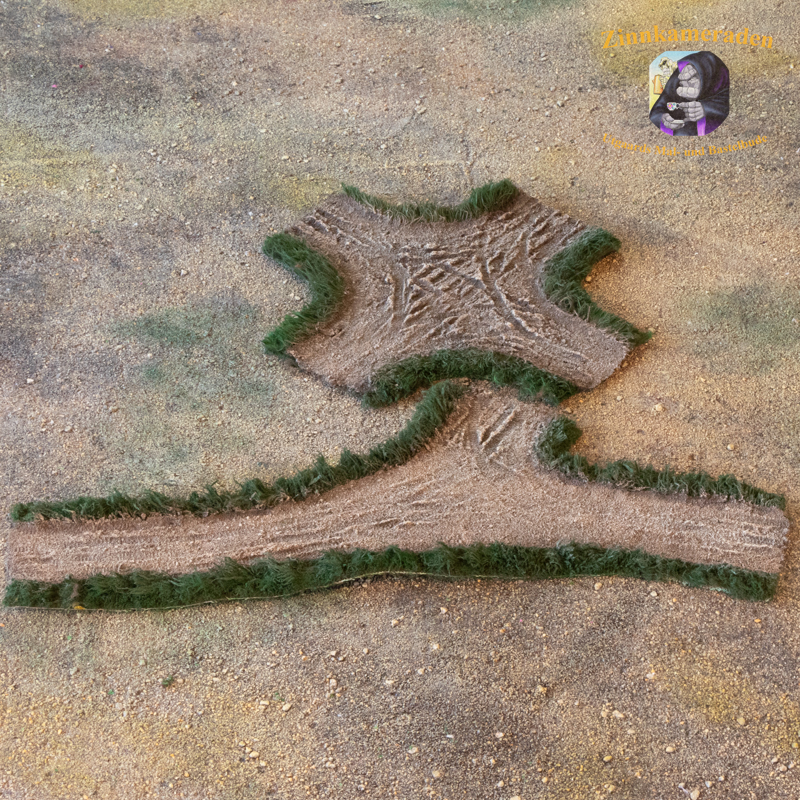
Terrain: Where the streets have no name - roads made from Fake Fur and Acrylic Caulking

Unpaved roads were next on my to-do list and of course, these should also be flexible so that they can adapt to hilly terrain.

The starting material was again fake fur, which I trimmed short at the edges and completely shaved off where the actual roadway runs.
Next came the colouring of the strips I left on the sides of the roads with various shades of brown and green as they should represent gras and so on..

After this had dried, I applied acrylic caulking with a palette knife, sprinkled sand over the wet mixture, smoothed it out with a narrow rolling pin and then pressed in some tracks.
As soon as the acrylic-sand mixture was completely dry (after about 24 hours), it was ready to be painted.

I still need a few more junctions and some narrower paths, which I will be building soon, before I want to try whether this method can also be used to create paved roads.
All in all I´m. happy how these roads turned out.

The finished roads and junctions so far:

My completed roads and junctions so far.

The straight ones ...

... and the curvy pieces.

Crossing and junction

15mm and 28mm miniatures and vehicles for size comparison.

Here you can see how flexible the sections are and how they can adapt to the ground.


Click here for a small how-to:

Tutorial: How I make Wheat Fields and Grassland from Fake Fur

Here is a little "How To" on how I make my fake fur fields and meadows.
There are countless techniques to achieve the same (and better) results, but this is the one that:
a) works best for me
b) is a good compromise between effort and time

I would recommend testing different techniques, as I did, as this is the only way to find the technique that suits you best.


First things first:
- It is advisable to wash the fabric thoroughly beforehand to remove any residue that could prevent the colour from sticking to the fabric later.

- Cut the fur to size and then gradually trim it to the desired length using a shaver (preferably one for small animals, as these devices are more robust), in my case 16mm.
I use different attachments for this and trim the length down step by step to the desired length.
Then use scissors to trim the fur in different places to achieve a natural look.

- Each layer of colour must be applied repeatedly from all sides and then always brushed in immediately. It is better to repeat this several times than to apply too much colour at once, because then the hairs of the fake fur will clump together!

- The colour must be allowed to dry between the individual layers, but the time can be shortened with a hair dryer.

- Take your time and don´t rush through the needed steps.


Lets get started with ...


In addition to the fake fur, you will need a shaver, scissors, various brushes and combs, as well as brushes in different sizes. I use inexpensive paintbrushes here, as they are quite strained when applying the paint to the fur.

The fur is cut to size and trimmed to the desired length.

The first layer of colour has been worked in, a dark mix of brown and green forms the basis of my wheat fields.

A bit of Sun-Yellow added to the above mix forms the next layer,

... followed by adding even more Sun-Yellow to the mix.

The next layer applied - this time pure Sun-Yellow. The difference to the previous step is clearly visible in comparison to the field in the background.

The next layer was mixed from a bit of Beige (Pale Sand) that I´ve added to the Sun-Yellow.


Starting with this step, the colour is only applied very lightly and in different places to the upper third of the hair, no longer to the entire surface.
This creates a natural "lively" look.

More Beige/Pale Sand added. This means that the appearance of the field comes closer and closer to its model when the wheat is ripe for harvesting.

Pure Beige/Pale Sand added as highlights - do this like you would do a Drybrush on miniatures, buildings, or bases. Now just comb in very lightly to blend in the highlight.

My finished Wheat Fields ...

... and the real thing.


I hope this little how-to is helpful for some of you when building your own fields and/or meadows.

I will answer questions in the comments as quickly and as well as possible, but this is only a hobby blog and so an answer can sometimes take a while if I have little time for the hobby.